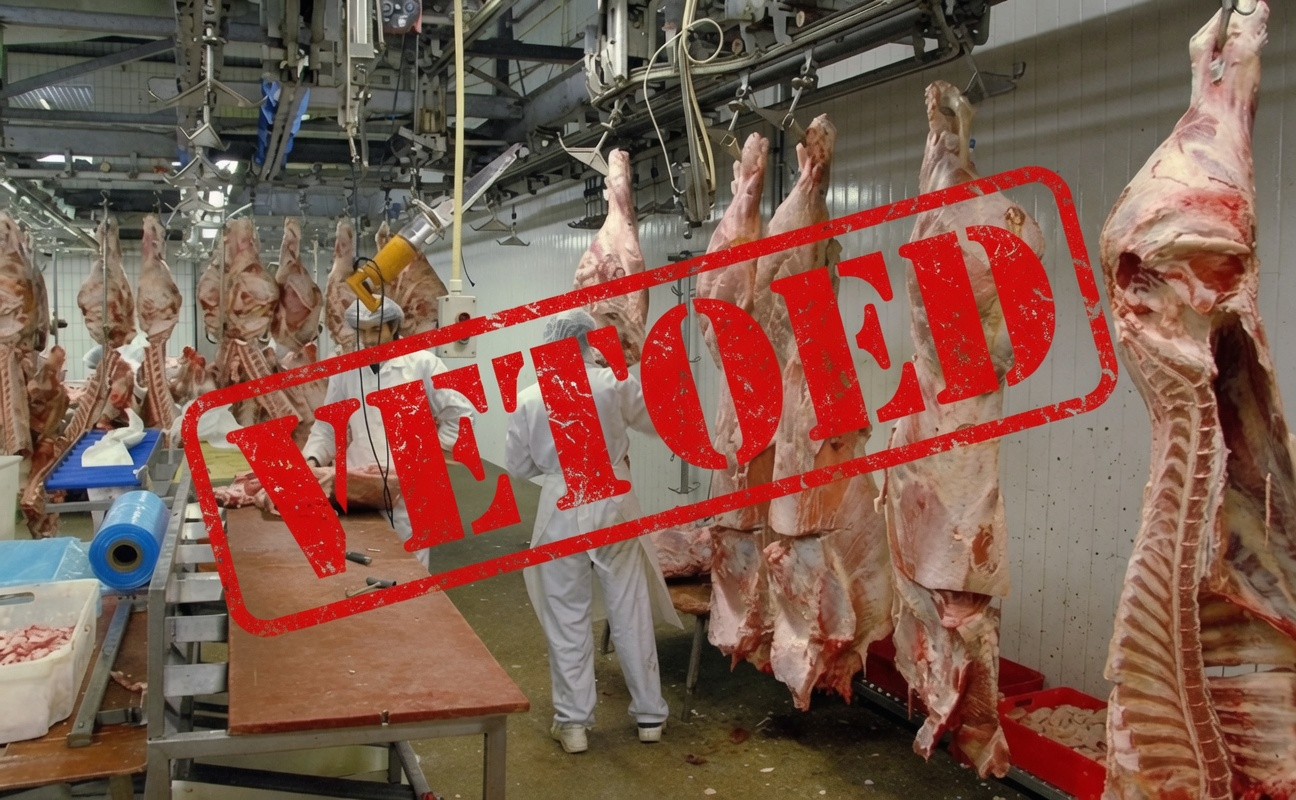
New Hampshire Has Four Slaughterhouses. The Governor Just Vetoed the Fix.
New Hampshire has four USDA-inspected slaughterhouses for an entire state, and its governor just vetoed the bill that would have worked around it. The law that created the bottleneck is the same one keeping four companies in control of the nation's beef supply.
Barbara Comtois represents Barnstead, New Hampshire, a town of roughly five thousand people spread across dairy country. Last November she sat in a hearing room while the state's own agriculture commissioner, Shawn Jasper, told the House Environment and Agriculture Committee he was "a bit horrified" by her bill. Her crime wasn't recklessness. It was writing into law what New Hampshire's ranchers already live with every fall: this state has roughly four USDA-inspected slaughterhouses, period, and that is the entire capacity available to every pasture-raised herd in the Granite State.
On July 10, Governor Kelly Ayotte vetoed House Bill 396, the bill Comtois built to work around that math. Ayotte didn't dispute the bottleneck. Her veto statement said New Hampshire "has not established its own Meat and Poultry Inspection Program and therefore, the state relies on federal inspection of these products." That single sentence is the whole indictment. It isn't a description of nature. It's a description of a choice — one New Hampshire has simply never reversed.
A program most states already run
Twenty-nine states operate their own meat and poultry inspection programs, certified as "at least equal to" the federal standard under a decades-old cooperative agreement with USDA's Food Safety and Inspection Service. Those states get a second lane: local inspectors, local capacity, local control over who gets to process a side of beef. New Hampshire built none of that. So when a small producer needs a slaughter date, there is exactly one door, and it belongs to Washington.
That door didn't open by accident. The Federal Meat Inspection Act of 1906 responded to real horrors in Chicago's packing houses. But the 1967 Wholesome Meat Act extended the same inspection mandate to intrastate sales, and the compliance costs that followed did something the original law never intended: they closed thousands of small slaughterhouses that couldn't afford federal-grade infrastructure. The vacuum they left didn't stay empty. It got filled by four companies — JBS, Tyson, Cargill, National Beef — that now run the boxed beef supply chain almost top to bottom.
The concentration the law built and never undid
The Packers and Stockyards Act was Congress's own answer to the first wave of consolidation in the 1920s, passed explicitly to assure fair competition and keep packers from turning ranchers into price-takers. It worked, for a while. Federal regulators later documented that the four-firm concentration ratio in beef had fallen to 26 percent by 1963 — real, functioning competition. Decades of mergers since have pushed that number back past 80 percent, and the same regulatory apparatus that once broke up the packing trusts now spends most of its energy confirming paperwork instead of breaking anything up.
That's not rhetorical. Ayotte's veto statement quotes USDA directly: the Office of Investigation, Enforcement and Audit said it was "not aware of any outstanding or unmet requests for inspection" in New Hampshire. The agency that helped build a four-plant state is also the agency certifying, on paper, that nothing is wrong. Ranchers lose a year of planning and a haul to Massachusetts. Consumers lose the direct-market option. The Big Four lose nothing, because the barrier the law maintains was never aimed at them.

More processors, fewer price fixers
There are ways out that don't require New Hampshire to break federal law, which is exactly what its own legislature keeps trying and its governor keeps blocking on legal grounds. The PRIME Act, reintroduced this Congress, would let state-inspected custom slaughter facilities sell directly to in-state consumers without full federal inspection overhead — a narrower fix than HB 396, built to survive the preemption fight instead of losing it. The Cooperative Interstate Shipment program already lets small state-inspected plants ship across state lines, if a state builds the underlying program New Hampshire has never funded. Either path decentralizes capacity instead of consolidating it further.
Ayotte's convening of small producers this September is the test. If it produces a real push for a state MPI program or federal cooperation on capacity, New Hampshire finally does what 29 other states did years ago. If it produces another set of meetings, the four-plant math holds, the wait stays a year, and the Big Four keep the only customer they've ever needed: a federal inspection regime that never had to lift a finger to protect its own market share.
This isn't a supply chain. It's a permitting system with a monopoly built into the paperwork.
New Hampshire has four USDA-inspected slaughterhouses for an entire state, and its governor just vetoed the bill that would have worked around it. The law that created the bottleneck is the same one keeping four companies in control of the nation's beef supply.
More in Farm Policy
 chevron_right
They Couldn't Buy Him. So They Bought His Seat.
May 21, 2026 · Beef News
 chevron_right
One farmer, one file, one surveillance contract: Palantir and USDA join forces.
Apr 26, 2026 · Beef News
 chevron_right
Michigan loses 100,000 acres of farmland — in 2024 alone!
Mar 23, 2026 · Breeauna Sagdal
 chevron_right
The Green Shoot America Can't Afford to Miss
Mar 10, 2026 · Beef News