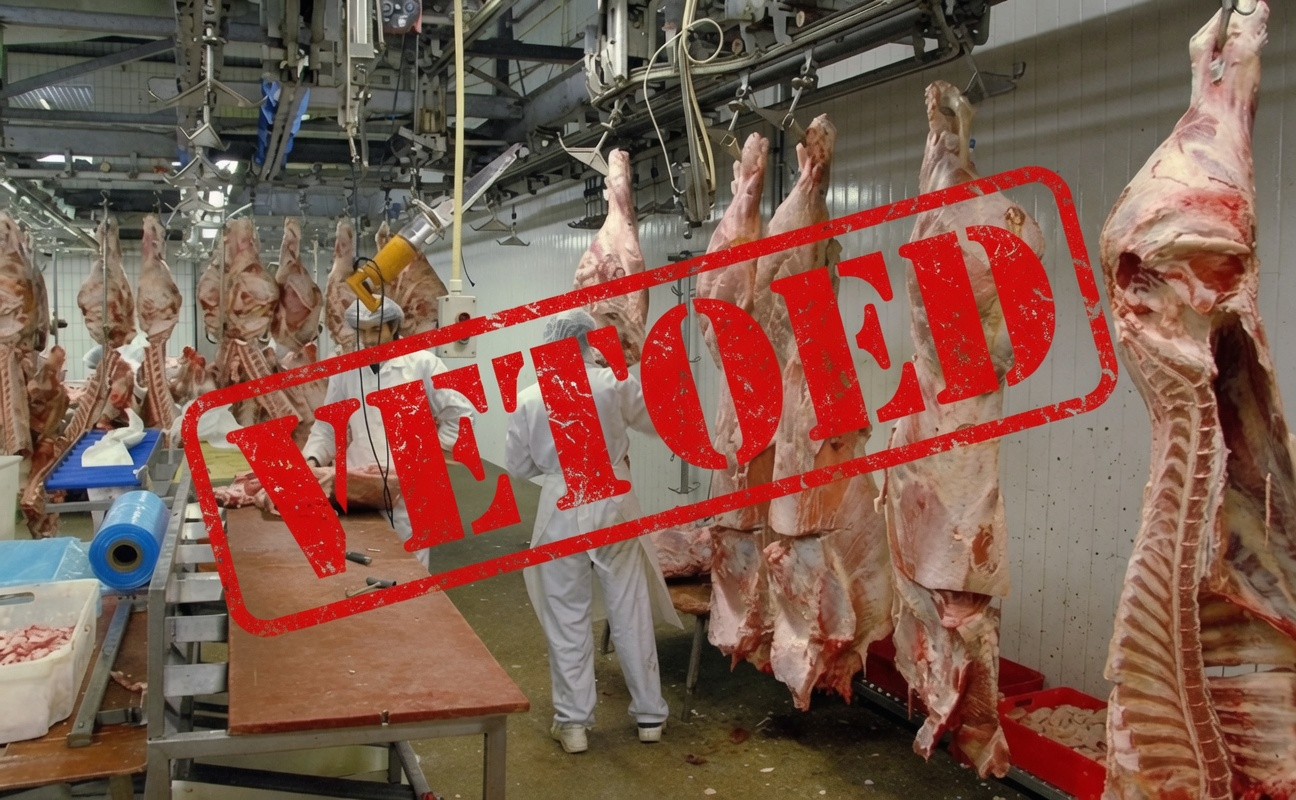
New Hampshire Has Four Slaughterhouses. The Governor Just Vetoed the Fix.
A New Hampshire lawmaker tried to fix her state's four-plant meat bottleneck. Her bill got vetoed — and the same 1967 federal law that killed it is the one that built the beef industry's four-firm monopoly.
Barbara Comtois represents Barnstead, New Hampshire, a town of roughly four thousand people in dairy country. She wrote House Bill 396 to give the state's smallest producers a way to sell meat without waiting on New Hampshire's four USDA-inspected slaughterhouses — the entire commercial processing capacity available to every rancher in the state. Producers book those four plants a year out and haul cattle to Massachusetts when they can't wait. Comtois's bill was a real attempt at a real problem.
It wasn't a workaround dressed up as reform. It was the only tool actually on the table, because New Hampshire never built the alternative that would have made asking unnecessary. HB 396 would have let a rancher sell a handful of animals a month straight to a neighbor — the same direct relationship that's kept small-scale meat trustworthy for as long as farming has existed — instead of forcing that rancher to wait a year for one of four inspected slots that don't exist in anywhere near enough supply.
Last November, state agriculture commissioner Shawn Jasper told the House Environment and Agriculture Committee he was "a bit horrified" by it. That reaction says more about the system than the bill: a state that only maintains one inspection lane treats any attempt to open a second one — even a narrow, direct-to-consumer one — as a threat, instead of treating fifty years of refusing to fund that second lane as the actual problem.
Governor Kelly Ayotte vetoed HB 396 on July 10 for that reason. Her statement said New Hampshire "has not established its own Meat and Poultry Inspection Program and therefore, the state relies on federal inspection of these products." That's not a dodge. It's an accurate description of a fifty-year-old federal wall — and it's the same wall that, since 1967, has closed thousands of small slaughterhouses nationwide and handed the capacity they left behind to whichever companies could afford to build for it.
The wall that killed the bill is the wall that built the Big Four
The Federal Meat Inspection Act of 1906 responded to real horrors in Chicago's packing houses. The 1967 Wholesome Meat Act then extended the same mandate to intrastate commerce: every state had to either run its own inspection program "at least equal to" the federal standard, or default to federal inspection alone. The compliance costs that followed — full-time inspectors, sanitation infrastructure, record-keeping — closed thousands of small slaughterhouses that couldn't justify the capital investment for low-volume throughput. None of that required a conspiracy. It required scale, and scale is exactly what closed thousands of family operations and exactly what four companies — JBS, Tyson, Cargill, National Beef — had.
The Packers and Stockyards Act had actually broken up an earlier round of consolidation in the 1920s. Federal regulators later documented that the four-firm concentration ratio in beef had fallen to 26 percent by 1963 — real, functioning competition, before the 1967 Act's compliance costs reversed a half-century of that progress. Concentration has been pushed back past 80 percent since. The four companies with the deepest pockets simply outlasted the wall everyone else got closed out by.
Twenty-nine states found a door around this wall. New Hampshire never built one.
Twenty-nine states operate their own meat and poultry inspection programs, certified as "at least equal to" the federal standard under cooperative agreements with USDA's Food Safety and Inspection Service. Those states get a second lane: their own inspectors, their own capacity, their own control over who processes meat for in-state sale. New Hampshire is not one of them, and never has been — a funding and staffing choice made by successive legislatures, not an inevitability. That's why the door for New Hampshire producers only opens one way, and it belongs to Washington.
Ayotte's veto statement quotes USDA directly: the Office of Investigation, Enforcement and Audit said it was "not aware of any outstanding or unmet requests for inspection" in New Hampshire. Read plainly, that means no one has filed the paperwork to formally ask for more capacity — not that the bottleneck isn't real. Producers still lose a year of planning and a haul across state lines. The Big Four lose nothing. They didn't have to lift a finger: the compliance costs that killed their competitors in 1967 still do the work for them, every single fall.

More processors, fewer price fixers
HB 396 tried to go around the wall. The paths that actually get through it exist and are on the table right now. The PRIME Act, reintroduced this Congress, would let state-licensed custom slaughter facilities sell directly to in-state consumers under state law — built with the federal framework instead of around it. The Cooperative Interstate Shipment program already lets small state-inspected plants ship across state lines, for any state willing to fund the MPI program underneath it. Either path adds real inspected capacity. Neither one asks a governor to sign something her own commissioner calls horrifying.
Ayotte's convening of small producers this September is where that choice actually gets made. Push for a funded state MPI program or real PRIME Act support, and New Hampshire finally builds the door 29 other states built years ago. Get another round of meetings instead, and the four-plant wait holds — not because anyone in Concord wants it that way, but because nobody has spent the money to change it.
Fifty years of economies of scale, and nobody in Concord has spent a dime to build a way out of it.
A New Hampshire lawmaker tried to fix her state's four-plant meat bottleneck. Her bill got vetoed — and the same 1967 federal law that killed it is the one that built the beef industry's four-firm monopoly.
More in Farm Policy
 chevron_right
Indiana Just Put a Ceiling on Its Own Health Department
Aug 11, 2026 · Beef News
 chevron_right
This isn't a labeling vote. It's a delegation vote.
Aug 6, 2026 · Beef News
 chevron_right
Forget 'Amnesty.' The Ag Labor Bill's Real Payload Is a Wage Cap and a Packing-Floor Carve-Out
Jul 21, 2026 · Beef News
 chevron_right
They Couldn't Buy Him. So They Bought His Seat.
May 21, 2026 · Beef News