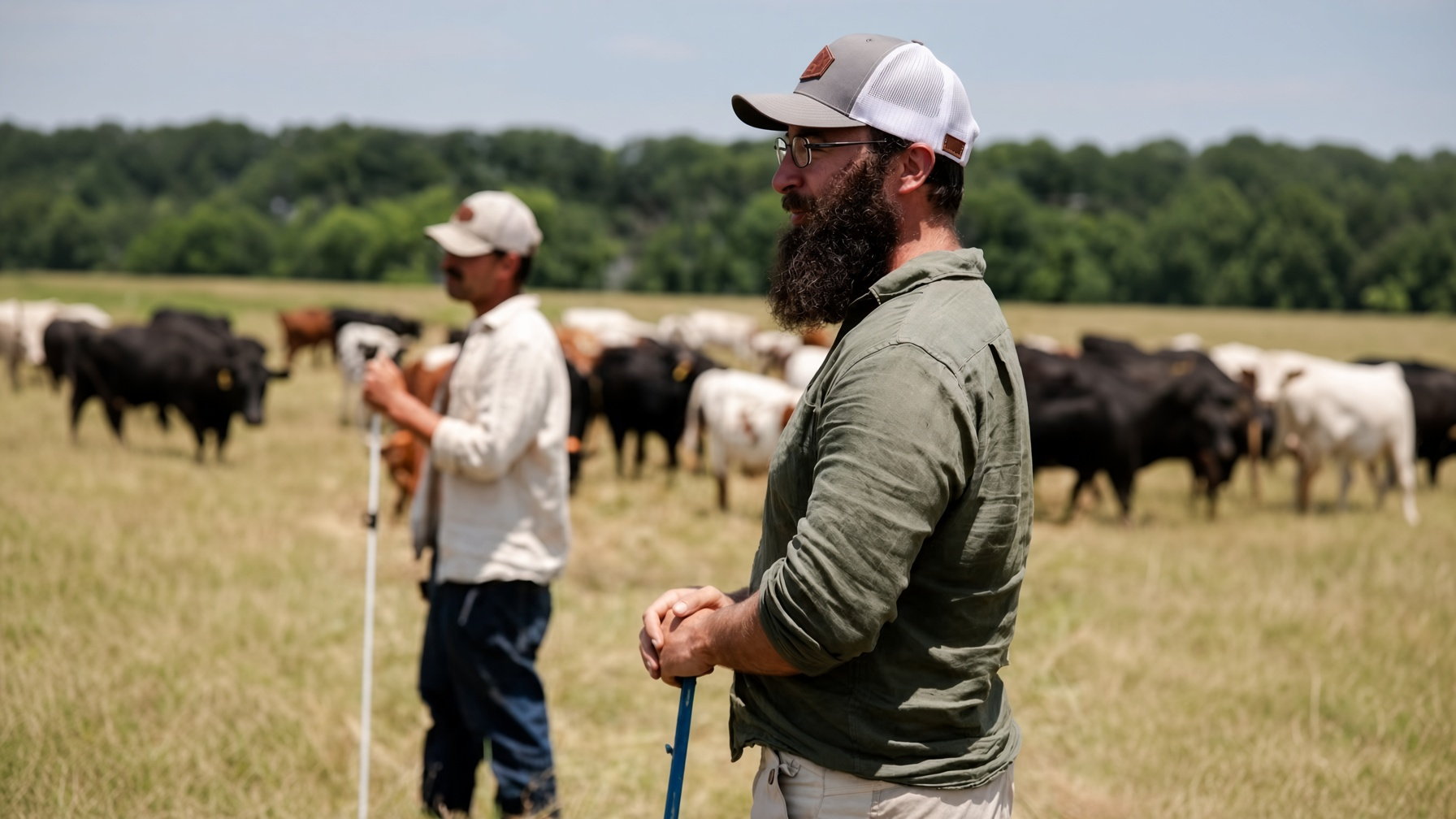
Oklahoma let a $191 million cattle fraud run for years. It's spent six months chasing a rancher whose cattle actually exist.
Oklahoma ended judicial deference to state agencies last November. Three months later, its own securities regulator opened an investigation into a Mayes County herdshare rancher — no complaint, no victim, no filed order, $20,000 a month.
Six months of subpoenas. Roughly $20,000 a month in legal fees. No complainant, no alleged victim, no fraud allegation, and no filed enforcement order naming the ranch. Since February, the Oklahoma Department of Securities has been investigating whether Joel Hollingsworth's herdshare program at Smoke River Ranch in Mayes County is an unregistered security. The argument over that question has been happening under the wrong framework.
The legislature already answered the question the agency keeps asking
Last November, House Bill 2729 took effect and ended judicial deference to state agencies in Oklahoma — the state-level version of the Chevron doctrine the U.S. Supreme Court killed in 2024. Courts, hearing officers, and administrative judges must now interpret a statute or rule independently, and where real doubt remains, the law tells them to rule in favor of "a reasonable interpretation which limits agency power and maximizes individual liberty."
The Smoke River investigation opened three months later, in February 2026. The reform was already the law of Oklahoma when the Department of Securities opened the file. Nothing about how the case has run since — the subpoenas, the pre-order cost, the absence of any public finding — reads like an agency operating under a standard built to limit its own reach in favor of the person it's investigating.
Everyone is litigating Howey. Oklahoma's statute reaches further — maybe too far.
The federal test comes from the 1946 citrus-grove case, which found an investment contract in a scheme built entirely around a promised financial return: buyers pooled money into groves they didn't work, and the payout was measured in dollars, distributed by the operator. Herdshare members don't receive a dollar return at all. They receive calves — to eat, sell, or give away as they choose — the same as the ranch itself does with the animals it keeps back. Nothing in the arrangement is denominated in profit.
Oklahoma didn't stop at Howey. Its own definition of a security reaches an investment of money or money's worth in the risk capital of a venture made with the expectation of "some benefit," where the investor has no direct control over policy decisions. On its face, that language reaches further than the federal test. But risk-capital doctrine was built to police ventures whose existence depends on the money coming in — construction that doesn't happen without buyers, an operation that doesn't exist until it's financed. Smoke River was already a working cattle operation before the first herdshare sold. Members aren't financing something into being; they're buying a claim on livestock the ranch already runs, and if the ranch failed tomorrow, the animals would revert to their owners rather than disappear with the venture. That's a different posture than the doctrine was written to catch.
Not profit. Not a return on capital. Benefit. Members carry no exposure to the ranch's financials at all — the arrangement functions as a service contract for the animals' care, no different in kind from paying a stable to board and feed a horse.
Beef is a benefit.
The consumption defense answers a question Oklahoma never asked
Hollingsworth's strongest doctrinal ground is the line the Supreme Court drew in Forman and restated in SEC v. Edwards: a purchaser "motivated by a desire to use or consume the item purchased" sits outside the securities laws. That reasoning is a gloss on the federal word profits. Oklahoma's risk-capital clause never uses that word. A defense built on wanting the beef rather than the money wins the federal argument and walks straight into the state one.

He calls it cropsharing for cattle. Oklahoma calls it agistment. Neither is new.
Title 4 has given anyone employed in feeding, grazing, or herding another person's animals a lien on those animals since 1910, with a parallel lien for anyone who keeps or boards them. Oklahoma has recognized the commercial reality of managing someone else's livestock for over a century. What it has never written is the other half: a securities exemption saying that co-owning livestock for your own table is not an investment contract.
Hollingsworth's own framing for the arrangement is blunt: cropsharing applied to cattle. Authority over day-to-day management is delegated to one operator rather than split across a committee, which he distinguishes from a cooperative — he calls it a collaborative. Members who don't like how the herd is run can pull their animals and take them elsewhere, the same leverage a landowner has over a sharecropper.
The ranch says it actively discourages the opposite read. Onboarding materials tell prospective members plainly that there is no money to be made, and that the only sensible reasons to join are ongoing food security and support for the model itself. Hollingsworth describes it as something closer to a crossover between collaborative farming and charitable giving than an investment — the functional opposite of buying in for a return.
The inversion
The institutional backdrop is real. In September 2025 the SEC obtained final judgments in the Agridime cattle scheme — $191 million raised on promises of 15 to 32 percent guaranteed returns, cattle never purchased in the numbers the contracts required, and $102.9 million in disgorgement. An agency that just lived through that is going to look hard at any pooled cattle arrangement.
But note the inversion. Agridime's investors owned cattle that did not exist. Smoke River's members can back a trailer up to the sorting pens.
The fix is a statute, not a verdict
The Department of Securities exists to protect people from being taken advantage of. In this case, the people it is nominally protecting are funding a legal defense against the department itself — spending money to keep the government out of an arrangement they entered voluntarily, with no complaint and no victim on file. That is not investor protection. That is the machinery running because it started running.
Oklahoma runs 1.97 million beef cows, second only to Texas, inside a national herd that contracted again this year with the calf crop down two percent. Every family that wants a direct ownership stake in that herd is operating in a category the securities code has never defined, under a deference standard the legislature has already retired. An agricultural safe harbor written into Title 71 — consumption-oriented livestock co-ownership, with physical delivery rights, is not an investment contract — settles the question for everyone, not only for Hollingsworth. Until it exists, the surest ground is the plainest one: know the rancher, know the animal, buy direct. That is what BeefMaps.com was built to make ordinary.
A statute takes a legislative session. Joel Hollingsworth doesn't have one. Right now the fight is being paid for in real time, out of pocket, at roughly $20,000 a month, against a case with no complainant and no victim. The single most useful thing a reader can do today isn't just to share a post or write a legislator — it's chip in to his legal defense fund. Every dollar buys him another week to keep fighting a case that should never have opened in the first place.
Oklahoma ended judicial deference to state agencies last November, requiring courts to interpret ambiguous rules independently and in favor of individual liberty. Three months later, its own securities regulator opened an investigation into a Mayes County herdshare rancher that has run ever since as if the reform never happened — no complaint, no victim, no filed order, $20,000 a month.
More in Investigative
 chevron_right
When the Compadre Builds the Packing Plant
Jul 9, 2026 · Beef News
 chevron_right
Sixty Years of Clean Land. Then the Cartels Sent the Cows.
Jun 18, 2026 · Beef News
 chevron_right
Washington State's Own Wetland Specialist Doubted the Case. They Fined the Farm $204,000 Anyway.
May 27, 2026 · Beef News
 chevron_right
The State is Evicting a Fifth-Generation Rancher for a Danish Energy Conglomerate
May 17, 2026 · Beef News